


Is there ever a world where Spain could play against one of its own regions at the World Cup? Athletic Club midfielder Oihan Sancet seems to think so as he voiced his support for Basque recognition ahead of their 1-0 friendly victory against Venezuela on Saturday night. On the topic, Sancet asserted ‘it’s what you dream of as a child, playing for the national team you love, and hopefully one day we can gain official recognition and find ourselves playing at a World Cup against the biggest teams’.

This is in reference to the Basque Football Federation’s (EFF) recently renewed plea to Spain’s Higher Sports Council (CSD) over international recognition, with the contest against Venezuela seen as an opportunity to display their competitive abilities amidst a global FIFA window. Citing Article 48.2 of the Spanish Sports Law in their submission, sporting bodies are permitted to seek participation should they evidence deep historical and social roots in the sport. This pathway has even proven successful elsewhere. Basque Pelota was successfully admitted to its international federation in December 2024, granting an independent national team to compete as a member association worldwide. That said, they did invent the sport.
This is also not the first time a footballing identity has been sought for the Basque region either, as in December 2020 the EFF applied directly to UEFA and FIFA. They argued that they shared the same circumstances as the current non-independent members, referencing Gibraltar (British territory), the Faroe Islands (Danish territory) and the constituent nations of the United Kingdom. This initiative failed, predominantly due to an alteration of the admission laws in 2001, which tightened the criteria for non-sovereign nations. Since Gibraltar and the Faroe Islands had submitted their claims before this change, and the football associations of the UK nations predate FIFA and UEFA entirely, their status as independent footballing organisations is entirely authorised. In their latest efforts, the EFF hope that an agreement with the CSD over Article 48.2 can reignite their ambitions, allowing a fresh bid backed by the Spanish authorities to be raised to UEFA.

However, on the rare chance that any accord is reached, there are still various hurdles to clear before any official admission from UEFA, who state that any prospective nation must be ‘recognised as an independent state by the majority of members of the United Nations’ and be ‘responsible for the organisation and implementation of football-related matters in the territory of their country’. Since the Basque Country is not currently recognised by any UN members, and its football federation operates within the Spanish structure, there remains quite a distance between their dreams and their reality. In fact, the Basque Country is still yet to make any official declaration of independence from Spain, or seek sovereign recognition from another country.
The History Behind Basque
Yet this does not mean that they aren’t politically autonomous. The victory against Venezuela on Saturday night sat within a broader commemoration marking the 90th anniversary of the first Basque Government, which laid the foundations for the present-day system. And although it doesn’t govern the entirety of the broader Basque region (which players can be selected from), it administers a broad range of domestic matters for the three provinces of Álava, Biscay and Gipuzkoa, each of which contains major cities such as Vitoria, Bilbao and San Sebastián. These three provinces individually contribute 25 elected representatives to serve the Basque parliament, effectively controlling all day-to-day matters such as healthcare, policing and education. Additionally, through the Concierto Económico, Basque institutions are authorised to collect and administer the majority of their taxes, allowing them to allocate funds where they deem necessary. In return, the Basque Government pays the Cupo, an annual contribution to the Spanish Government that covers its share of the national services under Madrid’s control.
Much of the reasoning behind these Basque desires is historical, with known human habitation in the region stretching back 200,000 years. In terms of modern identity, a significant portion of the Basque sense of distinctiveness is centered around language, as Euskera is commonly regarded as the oldest living tongue in Europe, with no linguistic relatives. Their geographical location has also helped to preserve identity, as their position in between the Pyrenees and the Cantabrian Mountains has assisted in maintaining isolated communities and traditional customs.
These practices became key once the three provinces joined the Crown of Castile in the 13th and 14th centuries, as the Spanish King only gained authority in the region once he had sworn to respect the local fueros (charters guaranteeing particular laws and privileges).
Yet following the Third Carlist War of the 19th century, a conflict over succession to the Spanish throne and preservation of traditional institutions, much of the foral system was abolished by the Spanish government. This was primarily due to the Basque’s wartime support for the Carlists, as well as a desire to bring all provinces under a more centralised legal and administrative system. After centuries of its existence, the abolition of the fueros intensified Basque opposition to Spanish rule, helping to inspire a growing nationalist movement.
A brief respite was attained with the 1936 Statute of Autonomy, granting a modern democratic self-government, yet it was crushed almost immediately by the Spanish Civil War. Believing the region’s identity threatened his ideals of a unified Spain, Francisco Franco’s forces captured Bilbao in 1937, revoking the privileges they had recently reattained. Speaking Euskera was prohibited alongside the display of regional symbols (e.g. Ikurriña), as political parties and organisations associated with Basque nationalism were repressed. Franco labelled the provinces as ‘traitors’ for supporting the Republican side, culminating in the destruction of the town of Guernica via bombing. Understandably, this strengthened Basque nationalism, and these grievances are still prevalent today. Following Franco’s death, progression was made towards reclaiming the Basque provinces their freedoms of the past, and the 1978 Spanish Constitution not only protected the historical rights of the fueros but also provided constitutional grounds for restoring the system of Basque autonomy.

Football played a significant role during these troubled years, becoming a vehicle for international political campaigning and domestic cultural resistance. Known as Euzkadi, the Basque Government organised a team to tour the globe, led by José Antonio Aguirre, a former Athletic Club player and the region’s first Lehendakari (president). The initiative had two aims: to raise money to support the Basque Government during the war, and to promote the Basque and Republican cause internationally, spreading awareness of their distinct national identity. Beginning in France in April 1937, the squad visited nine countries on their travels, including Czechoslovakia, Norway and the Soviet Union. They even settled in Mexico for a year, playing in the top flight during the 1938/39 season under the name Club Deportivo Euzkadi, finishing second. Following the defeat of the Republicans in 1939, the Basque Government went into exile, and with no war effort to fund, C.D Euzkadi officially disbanded, with many of their players finding playing careers across Latin America.
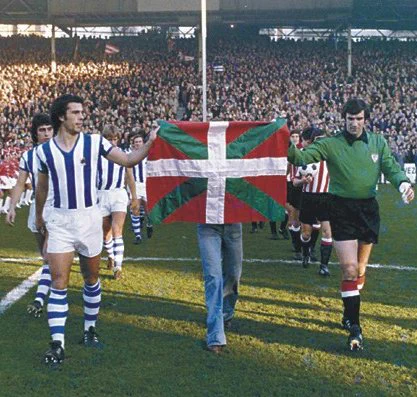
However, football’s role as a conduit for Basque identity did not stop with the cessation of the war, and was aided particularly through two clubs that maintain prominence today, Athletic Club and Real Sociedad. Despite Franco’s dictatorship suppressing Basque character, football provided an opportunity to express regional pride and cultural belonging. Athletic Club’s policy of only selecting Basque players certainly contributed, as their identity remained visible on a national scale, effectively providing an outlet for cultural representation despite the ban on regional symbols. One especially poignant moment occurred in 1976, as following Franco’s death the year prior, both Real Sociedad and Athletic Club captains entered the pitch holding the Ikurriña, the unofficial symbol of the region. At the time, the flag remained forbidden under the Francoist political system, with the image becoming an iconic moment in Basque football history. One month later, it was legalised.

This brings us back to what the EFF are fighting for today, international recognition for the Basque national team. And whilst there’s no doubt they would make inroads on the pitch (6 members of Spain’s World Cup winning squad + Luis De La Fuente are eligible), it remains to be seen if the same progress can be made off it. With approximately 3.2 million people expectantly waiting for the outcome, I too will have my fingers crossed it can be second time lucky for Euskal Selekzioa.

Leave a Reply