
The False 9 is one of the most intriguing and influential roles in modern football. It is a position that sits between two worlds, part midfielder and part forward. It’s evolution across the last two decades has shaped many of the best teams in Europe. At its core, the False 9 is a player who begins in the central striker position but frequently drops into midfield to create overloads. They will manipulate defensive structures and open spaces for runners. This movement challenges defenders to either follow into uncomfortable areas, or hold their line and risk allowing the False 9 too much freedom.
The role owes its foundations to Johan Cruyff’s Barcelona in the 1990s, where fluidity and positional interchange were fundamental principles. Cruyff believed that the player at the top of the attack should not simply stand on the shoulder of defenders. But should create and connect, drawing opponents into traps and allowing his team to dominate the ball. Although Cruyff did not use the term False 9, the ideas he planted became the basis for everything that followed.
L’Ottavo Re di Roma
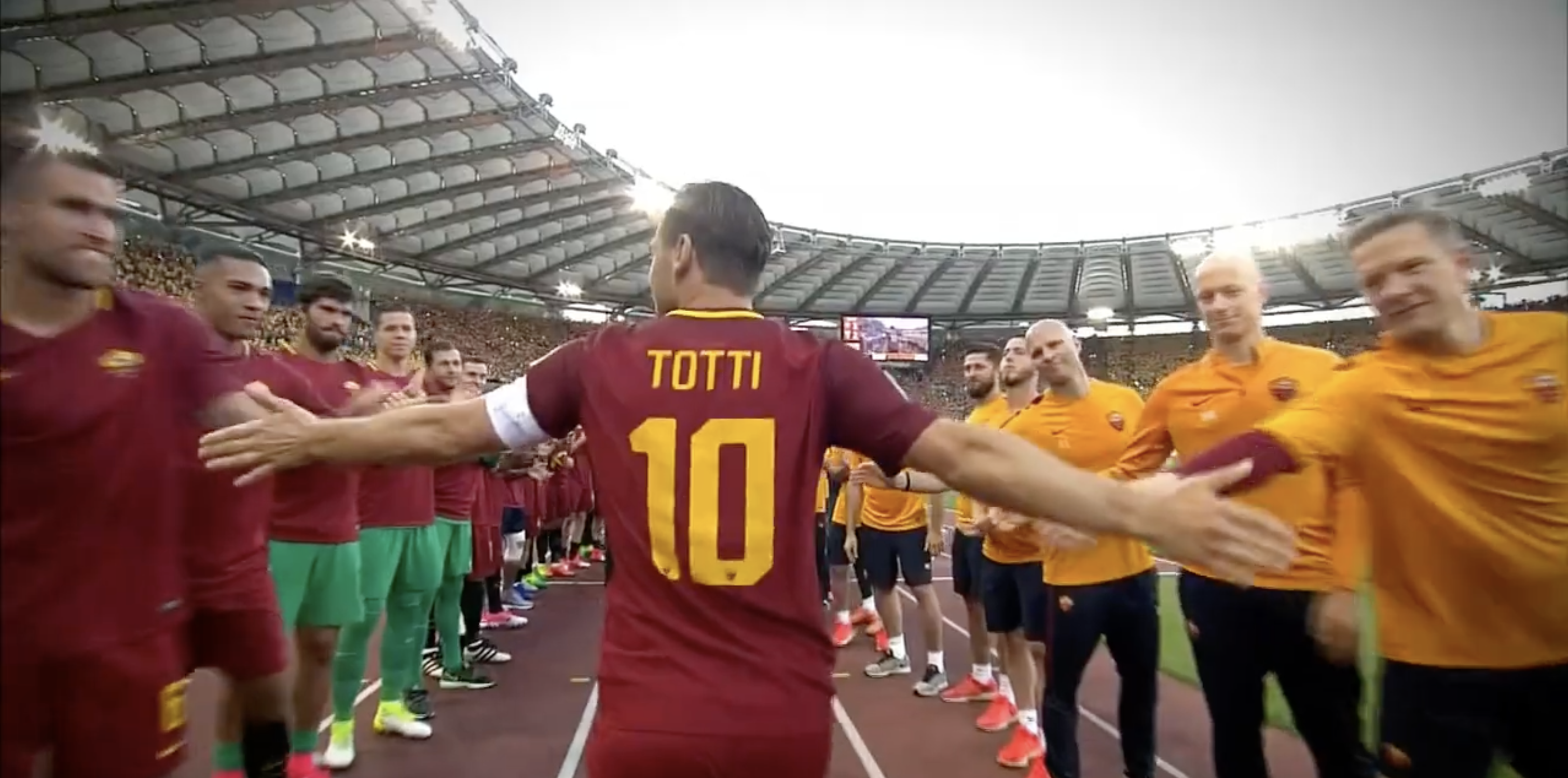
The ‘Eighth King of Rome’, Francesco Totti, is perhaps the most famous iteration of a true False 9. He played the role for Roma under Luciano Spalletti in the mid-2000s. When Spalletti made the bold decision to remove a traditional striker from the team and place Totti at the top of a system built on movement, creativity and constant positional shifts. Totti was the ideal player to bring this idea to life. He possessed the technique of a classic No. 10 and the finishing ability of a centre forward. As he combined those qualities with the intelligence to understand where the game needed him at any moment. Rather than competing physically with centre backs, he drifted into midfield, received the ball on the half-turn and dictated the direction of Roma’s attacks.
Totti’s clearest example of working as a False 9 came in the 2006–07 season under Spalletti. Roma shaped their attack around his willingness to drop off the front line, and the numbers from that year show how much influence he had. He finished the Serie A campaign with 26 goals, the highest in the league,. Ending the campaign with 32 in all competitions. He also contributed 15 assists, a reminder that his job was as much about linking midfield to attack as it was about finishing chances.
This mix of output and involvement is what defined his version of the role: a forward who set the tempo, created space for runners, and still carried the main scoring load. That season earned him the European Golden Shoe and stands as the clearest example of how a False 9 can become the focal point of a team without ever playing as a traditional striker.
Pep Guardiola and Lionel Messi

Messi was already the most dangerous player on the planet, but Barcelona had not yet found the shape that let him influence every phase of the game. That changed in 2009 when Guardiola brought him inside and used him as a False 9. From that point Barcelona gained an extra midfielder in possession and a forward defenders could not pin down. Step out and Messi found runners in behind. Hold your line and he dictated the play in front of you. The 6 to 2 win at the Bernabeu showed the impact clearly because Madrid never settled and never worked out where Messi would appear next.
What made the shift so important was how simple it looked once it worked. Messi dropped into spaces that centre backs and midfielders were not used to defending and the full structure of Barcelona tilted around those movements. The wide forwards had more space to attack. The midfield had more control of the rhythm and the team created chances from angles that opponents struggled to close. Guardiola recognised that Messi’s ability to operate between the lines was unmatched and by moving him into the central corridor he produced one of the most effective attacking shapes the modern game has seen.

Messi’s interpretation of the False 9 was not the same as Totti’s but the logic behind it was familiar. Both players manipulated the shape of the opposition and created superiority in the areas that matter. The difference was the scale. Messi had the technical level and the decision making to turn a tactical idea into a defining feature of an era. And Guardiola had the clarity to build a system that made that possible. It is one of the reasons he stands in the argument for the greatest manager of all time. Not only because he had the best player ever… but because he understood better than anyone how to unlock the full weight of his talent.
Klopp and Firmino

Over the following decade, the False 9 became a valuable tool for managers who wanted fluidity. Rather than fixed, rigid positional roles now in the modern game. One of the best modern examples is Roberto Firmino at Liverpool. Jurgen Klopp used Firmino as the connection point in a fast, aggressive and vertically oriented system. Firmino was not the primary scorer, but he was the player who allowed the entire structure to function. He dropped into midfield to create passing triangles, pressed intensively from the front and coordinated Liverpool’s defensive shape. By withdrawing into deeper areas, he opened corridors for Mohamed Salah and Sadio Mané to attack. Firmino was constantly scanning and adjusting his positioning to support the build up.
Klopp often described him as essential to the system because he unified the movements of the front line and linked play between midfield and attack. Firmino demonstrated that a False 9 can exist in a team that plays with high intensity rather than patient possession. His version of the role was defined by work rate, pressing intelligence and combination play. It reshaped how Premier League teams defended against Liverpool. The most underrated Liverpool player in recent time perhaps?
La Joya

Paulo Dybala offers another angle on the evolution of the False 9. Across his time at Juventus and Roma, Dybala has often drifted into central pockets to link play and create chances. Although he is not always deployed as a pure False 9, many of his natural instincts fit the role. Dybala excels at receiving between the lines, combining quickly with teammates and breaking defensive structures through his left foot.
At Juventus under Allegri, he frequently operated in a hybrid position that combined aspects of a second striker, a No. 10 and a False 9. His tendency to move away from the forward line into midfield areas helped connect Juventus’ transitions and allowed more direct attackers to occupy the highest spaces. Dybala’s interpretation highlights how the False 9 concept has blended with other creative roles. Modern forwards are often asked to drift, create and link rather than hold a fixed position. Dybala is a prime example of a player who thrives in that fluidity. During his time at Roma he has been given positional free rein, showcasing his ability in these positions.
England, Guardiola and Foden

The next evolutionary step may involve Phil Foden. Under Guardiola at Manchester City, Foden has already been used as a central forward on several occasions. Most notably during the 21/22 season, following the departure of main striker Sergio Agüero to Barcelona. His close control, positional awareness and speed of decision making suit the False 9 role. Foden understands how to occupy half spaces, drop into midfield at the right moments and accelerate into danger zones with the ball. He also has the finishing ability required to turn chances into goals, showcased once again by his brace against Leeds United this weekend.
If England and Thomas Tuchel look for a Harry Kane alternative, Foden could become the ideal False 9. England have traditionally relied on classic centre forwards, such as the great Harry Kane. However, Kane’s game has adapeted to already perform some False 9 functions through his world class link up play. Every England fan (to the annoyance of most) know how Kane loves to drop deep and recieve the ball.
“If Phil stays in his shape and form, I have no problem [playing him as a No 9]”
Foden could be more than just another attacking option for England. Deploying him centrally, as a creative False 9, may be exactly what gives England a flexible, unpredictable edge heading into the World Cup. With his movement between the lines and ability to link play under pressure, Foden could unlock space for wide players like Bukayo Saka or Cole Palmer. While simultaneously offering a dangerous finishing threat himself. That setup also gives midfielders such as Jude Bellingham, more freedom to box-crash into the box. Arriving late behind the forward line and adding another layer of unpredictability in attack. Rather than shoehorning England’s top talents into awkward positions just to fit them all in, this approach allows each to play where they can be most effective.
Fàbregas and Euro 2012

One of my personal favourite examples of the False 9 came when I was just eight years old, watching Spain at Euro 2012 and seeing Cesc Fàbregas play that role. In that tournament he featured in all six games and contributed directly with 3 goals for La Roja. Spain’s system back then relied on possession and control rather than direct attacking play, and Fàbregas thrived in the role. His vision and composure under pressure, along with his ability to maintain tempo, made him the perfect central pivot for a team that did not need a traditional striker to generate goals. For me, that Spain team remains a defining illustration of how the False 9 can be adapted to suit a player’s intelligence and technical talent rather than physical profile.
The Future
The future of the False 9 will depend on how teams defend. As pressing systems become more aggressive and defensive lines push higher, the need for forwards who can drop into midfield and connect play becomes even more pronounced. The False 9 may not always appear in its classic form, but the principles behind the role continue to shape modern attacking structures. While many leagues such as the Premier League seem to have reverted back to stereotypical big striker who only ever touches the ball when he scores. Trends come back around and it won’t be long until we see the false 9 come back into favour. For one reason or Another.

Leave a Reply